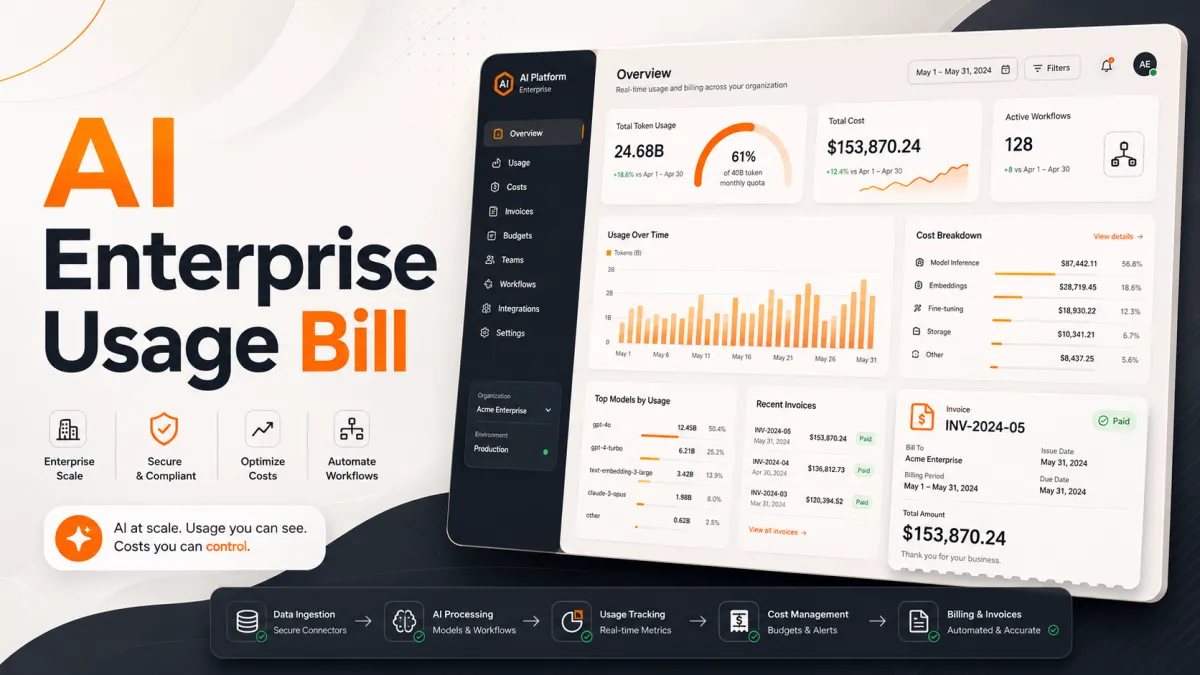
AI Enterprise usage bill
How to Spend Less Money on AI
You might have seen the big news. Microsoft put billions of dollars into a company called Anthropic. They did this even though they already own part of another AI company called OpenAI. The numbers are huge. Microsoft will spend something like $190 billion on AI this year.
Those numbers are fun to look at. But they don't help you at all.
When a giant company spends $190 billion, that is a big bet on the future. But when your company's AI bill keeps going up and up, that is not a plan. That is a leak. It is like leaving the water running. The good news? You can fix the leak. And you don't need to be a giant company to do it.
Here is what really helps.
Don't use the big tool for small jobs
This is the number one fix. Most teams skip it.
You don't need the biggest, most expensive AI to do small jobs. Things like sorting emails. Or pulling a date off a form. Or putting a support ticket in the right pile. But that's what most teams do. They set up the big AI once, it works, and they never change it.
Use a small, cheap AI for the easy stuff. Save the big, costly one for hard thinking. People call this "routing." On its own, it can cut your bill by 60 to 80 percent. Not a little. A lot.
Here is the trap. The cheap AI feels worse. So people grab the big one to be safe. But you are not giving it a test in school. You just need it to do one small job over and over. For most small jobs, the cheap one works fine. Try it on your real work and see.
Stop paying for the same thing twice
Say you run a help bot. Or a search tool. You probably send the same big chunk of words with every single question. The same rules. The same company info. The same long list.
And you pay full price for those same words every time. That's a waste.
There is a trick called "caching." You pay full price once. Then every time after that, you pay only a tiny bit. If you send the same stuff again and again, this is one of the best fixes you can make. It is often a quick change in the code. If your bill is big and you don't do this yet, start here this week.
Do slow jobs at night
Not everything needs an answer right now.
Some jobs can wait. Like making reports overnight. Or sorting a big pile of files. Or adding tags to a database. No person is sitting there waiting for these.
If a job can wait a few hours, you can run it in "batch." That means it runs at about half the cost. So split your work into two piles. Pile one: "someone is waiting." Pile two: "no one is waiting." Everything in pile two should run the cheap, slow way. Most teams never split it up. So everything gets the fast, costly price by mistake.
Watch how much the AI says
Here is a thing people miss. When the AI talks, that costs more than when you ask.
So an AI that goes on and on is burning your money. Three easy fixes:
Set a limit on how much it can say.
Ask for short answers. A list. One sentence. Not a whole essay.
Stop asking it to "explain its thinking" when you don't even read that part.
An AI that answers in 40 words instead of 400 is faster. And it saves money on the priciest part of the bill.
Grab one page, not the whole book
The lazy way is to dump your whole pile of company info into the AI every time. People think this helps. "Now it has everything!"
But it costs a lot. And it makes the answers worse. More junk, not more help.
Instead, pull only the one part you need for each question. Less stuff means fewer words. That means less money. And the answers get better, because the AI is not digging through 50 pages to find one line. This is a rare case where cheaper is also better. Take the free win.
Don't pay the sticker price
If you spend real money on AI every month, you should not pay the full price tag.
This is the real lesson from the Microsoft news. Those huge deals are just a promise. The company says, "We will spend this much." And in return, they get a better price. Normal companies can do the same thing. If you use AI a lot and it's steady, you can ask for a better deal. Most money teams fight hard on every other bill. Then they pay full price for AI. Don't be that company.
The big bet under all this
Now the chip news makes sense. Microsoft wants its own chips. Anthropic uses chips from Amazon and Google. Why? They all want to make AI cheaper to run. Cheaper chips mean lower prices for everyone down the line. That means you.
So time is on your side. AI keeps getting cheaper. But don't just sit and wait. Your bill is high today. And every fix above works today.
Your simple plan
If you do nothing else, do these three things this month:
Check which AI runs where. Move all the small, easy jobs to a cheap AI. This is your big 60 to 80 percent win.
Turn on caching for stuff you send again and again. Quick change. Big payback.
Split fast jobs from slow jobs. Push the slow ones to the cheap batch way.
Then ask for a better price and keep the answers short.
None of this is fancy. It's the same thing you'd do with any bill that got too big. Find out where the money goes. Then stop paying for stuff you don't need. AI feels like a mystery because it's new. It's not. It's just one more bill. And bills get smaller when someone pays attention.


