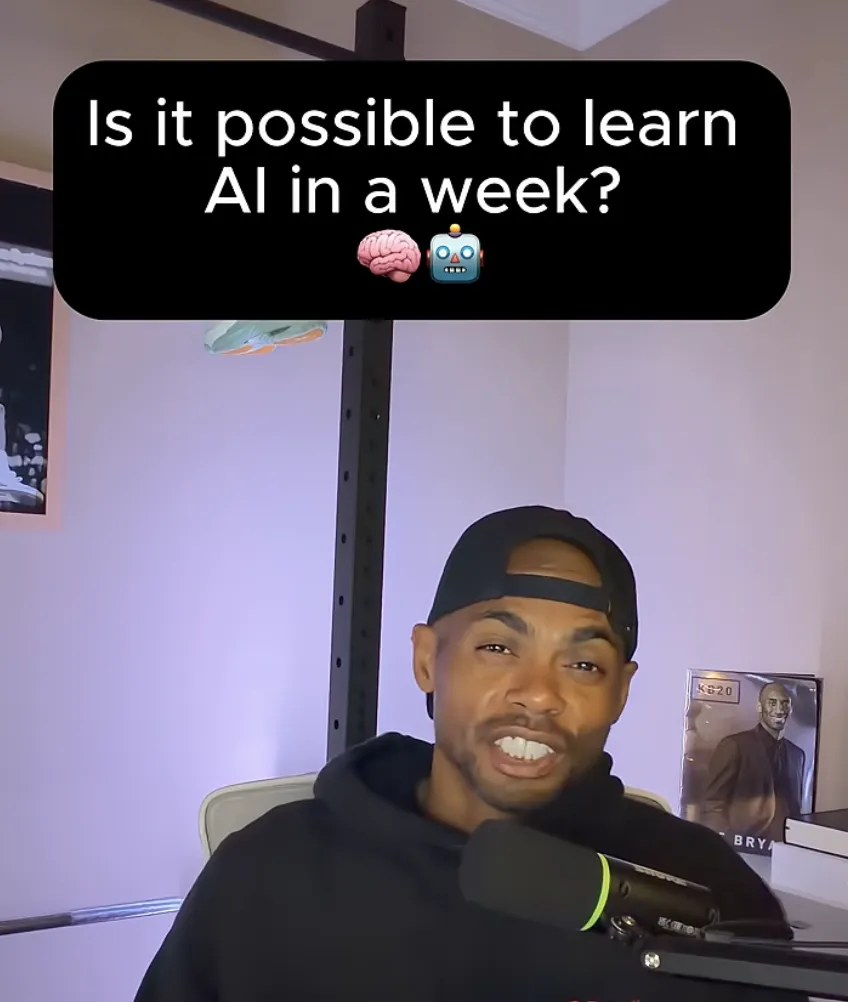
AI certified in 1 Week
The Best AI Courses to Learn From (And Why You Don't Need a Degree to Get Good at This)
There's a quiet myth floating around: that to actually understand AI, you need a university program, a bootcamp, or a CS background. You don't. AI proficiency — the kind that makes you noticeably better at your job, studies, or side projects — can be built in weeks using free online courses. The catch isn't cost. It's knowing which ones are worth your time.
Most "best of" lists hand you twenty options and leave you paralyzed. Below are five courses that, taken together, move someone with zero background from "AI is confusing" to "I use this every day and get real work done with it."
Why Free Beats Formal
The bigger claim is worth pausing on: free, self-paced courses beat expensive formal education for most people getting started. AI tools change every few months — a degree program designed in 2024 is already outdated by 2026. Meanwhile the companies building these tools — Anthropic, Google, OpenAI — publish their own training materials, update them constantly, and give them away. When the people who made the technology are also the people teaching it, for free, that's an unusual moment. Use it.
Free courses also let you fail cheaply. Start three, abandon two, still ahead. That's not something you can do with a tuition bill.
Course 1: AI Prompting for Everyone — DeepLearning.AI
Best for: Total beginners who want one skill that transfers everywhere.
DeepLearning.AI, run by Andrew Ng, put this out as a universal on-ramp. It teaches prompting — how to ask AI tools the right way to get the result you want — without anchoring you to a single product. What you learn applies to ChatGPT, Claude, Gemini, and whatever shows up next year.
Prompting is the highest-leverage skill in the AI stack. The gap between mediocre and useful output is almost never the tool — it's the prompt. Spend a weekend here and your output from every AI tool will improve immediately. Short, well-structured, assumes nothing. If you've never used AI seriously, this is the door.
Course 2: Claude CoWork for Beginners
Best for: Non-technical professionals who want AI to actually help with daily work.
If Course 1 teaches you how to talk to AI, Course 2 teaches you how to work with it. Claude CoWork for Beginners is built for people who don't code and don't want to. The focus is practical workflows — handling email, drafting documents, organizing files, summarizing meetings, planning projects.
This is the one I'd recommend to a parent, a small business owner, a teacher — anyone whose job description doesn't include "developer." It frames Claude as a co-worker rather than a magic box, which is exactly right for getting durable value out of AI. Expect to come out with repeatable habits you'll use the next morning.
Course 3: Anthropic's Official Claude Course
Best for: Beginners ready to go a layer deeper without becoming an engineer.
Anthropic — the company that builds Claude — offers their own free, more in-depth course. It steps slightly into technical territory: how Claude works under the hood, what context windows are, how to structure complex prompts, and when to use features like artifacts or projects.
It's not for people who panic at "API," but it expects you've played around with AI and now want to know why certain things work. Most people who finish it report a noticeable jump in how confidently they apply AI to harder problems. If Courses 1 and 2 left you wanting more substance, this is the next stop.
Course 4: Google Skills
Best for: People who learn in short bursts and want broad exposure.
Google Skills is structurally different — a library of 74 short sessions, each about 10 minutes, covering practical use cases like study support, event planning, research, writing, and organizing your week.
The format is the magic. Knock out a session over coffee, try it that afternoon, come back the next morning. Over a few weeks, you accumulate a surprisingly broad toolkit without ever sitting through a long lecture. It's also a good antidote to treating AI as one specific tool for one specific job.
Course 5: Practical AI for Business Owners
Best for: Anyone running a business, freelancing, or trying to turn AI into income.
The previous four focus on capability. This one focuses on application — using AI to make money. The audience is small business owners, solo operators, freelancers, and side-hustlers. The framing is unapologetically practical: which workflows save time, which automations earn back their cost, which use cases are worth investing in versus shiny distractions.
If you don't run a business, skip it. If you do — even informally — it's the most ROI-positive course on the list. One caveat: quality varies wildly here. Look for concrete examples and specific tool names. Avoid anything promising to "transform your business" without saying how.
A Suggested Path
If you want a sequence rather than a buffet:
Start with AI Prompting for Everyone to build the foundation.
Take Claude CoWork for Beginners to apply it immediately.
Sprinkle in Google Skills sessions whenever you have ten minutes.
Move to Anthropic's official Claude course once those feel comfortable.
If you run a business, Practical AI for Business Owners is the capstone.
The whole sequence is doable in four to six weeks at a relaxed pace — roughly one weekend per course. No tuition, no prerequisites.
The Real Takeaway
The reason to learn AI right now isn't fear of falling behind. It's that the skill ceiling is unusually low and the floor is unusually high. A few weeks of focused effort puts you above the median user in a way almost no other technology rewards so quickly.
The courses above aren't perfect. Some will age out within a year. That's fine. The goal isn't to find the one perfect course — it's to spend a few deliberate hours with material made by people who know what they're doing, build a couple of working habits, and keep going on your own.
You don't need permission or a credential. You need a free afternoon and a willingness to try the exercises. That's the whole gate.


